
What if the future you're preparing for isn't the one that arrives?
Your destination hasn't changed. The conditions have.
You may be perfectly clear about where you're going. What’s uncertain is what you might encounter along the way.
Every strategy inherently contains assumptions about the future. Scenario planning makes those assumptions visible — and deliberately explores what could happen if the world develops differently.
Rather than betting everything on one expected future, in a scenario planning exercise your leadership team develops several plausible future business landscapes and asks:
What would each of these futures mean for us?
The outcome is a clearer understanding of the possibilities — allowing you to make better, more flexible decisions today.

WHAT DOES SCENARIO PLANNING DO ?
Four futures. Not four predictions!
Scenario planning doesn't try to forecast what will occur. Instead, we identify important external forces that could reshape your strategic environment — but are beyond your control. In particular, we focus on those whose future development is, at the moment, genuinely uncertain. This is because depending on how they do develop, the future could unfold in different ways. Perhaps dramatically different.
From these critical uncertainties, we construct several contrasting future business landscapes in which you might plausibly find yourselves operating.
Then the important work begins. For each of these future landscapes — or “scenarios” — we now ask:
What opportunities could emerge for you?
What challenges would you likely face?
How well would your present strategy hold up to the changes?
What might you need to do differently?
The objective isn't to choose your preferred scenario; it's to see how you can prepare your organization — whichever way the world moves.
HOW DOES IT WORK ?
A highly logical process — but with plenty of room for creativity
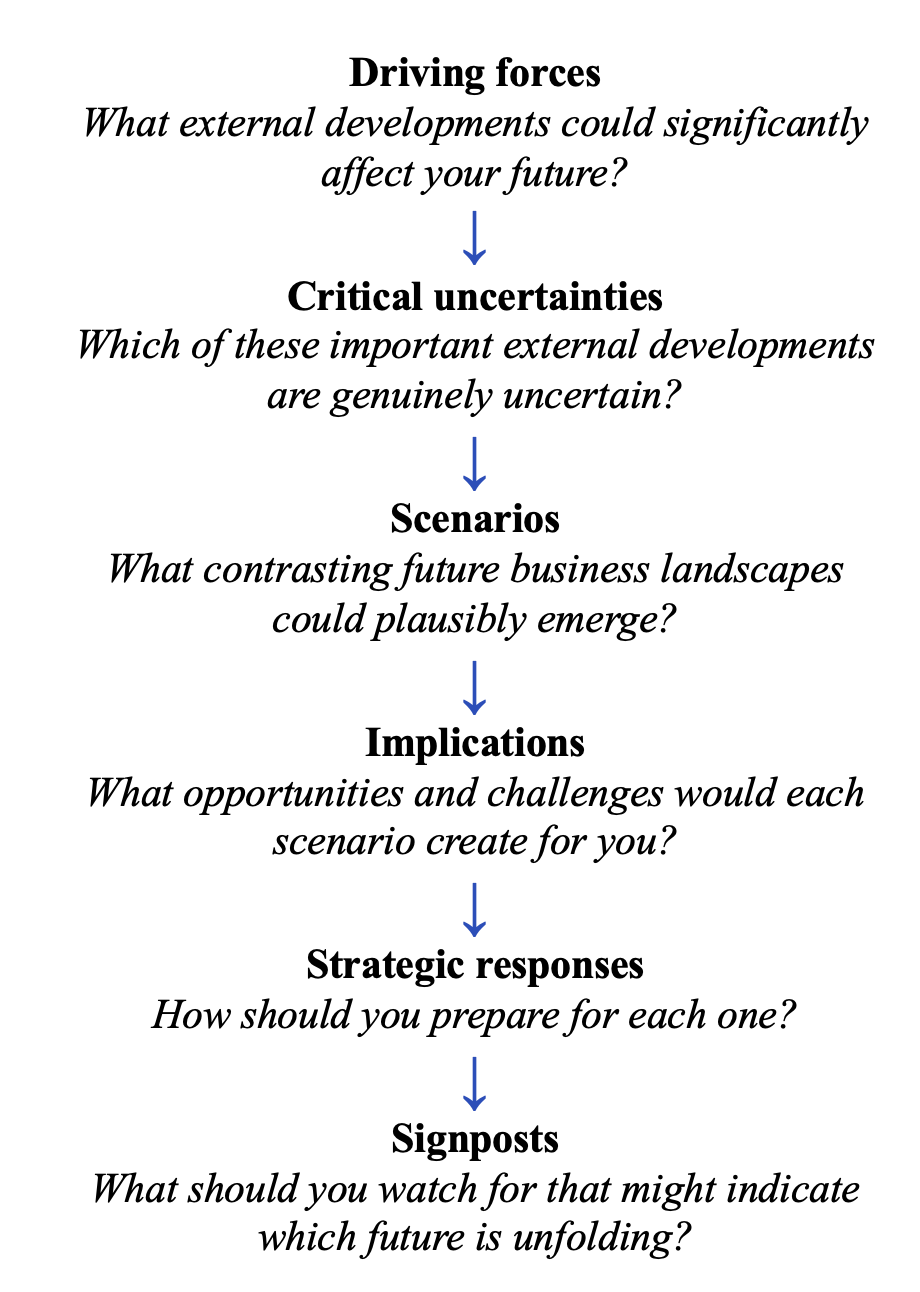
We follow a clear line of thinking
A typical scenario generation workshop takes about two days.
The process is structured, combining analysis, applied imagination, discussion and evaluation, with participants doing some serious thinking rather than being presented with somebody else's forecast.
By the end of the process, the team has developed a shared set of alternative futures, a clearer understanding of their implications, possible strategic responses to each, and a practical way to watch for evidence of which landscape may be emerging.
WHAT DOES A WORKSHOP ACTUALLY FEEL LIKE ?
The value of scenario planning doesn’t only lie in the actual scenarios.
Just as valuable is the dynamic interaction among the participants creating them.
A scenario workshop puts a leadership team into conversations it doesn't normally have.
People challenge each other’s assumptions. They compare different interpretations of what's happening outside the organization. They discover where their colleagues see the future differently. And overall, everyone considers possibilities that may never appear in the normal planning cycle.
This can make the process as valuable as the scenarios themselves.
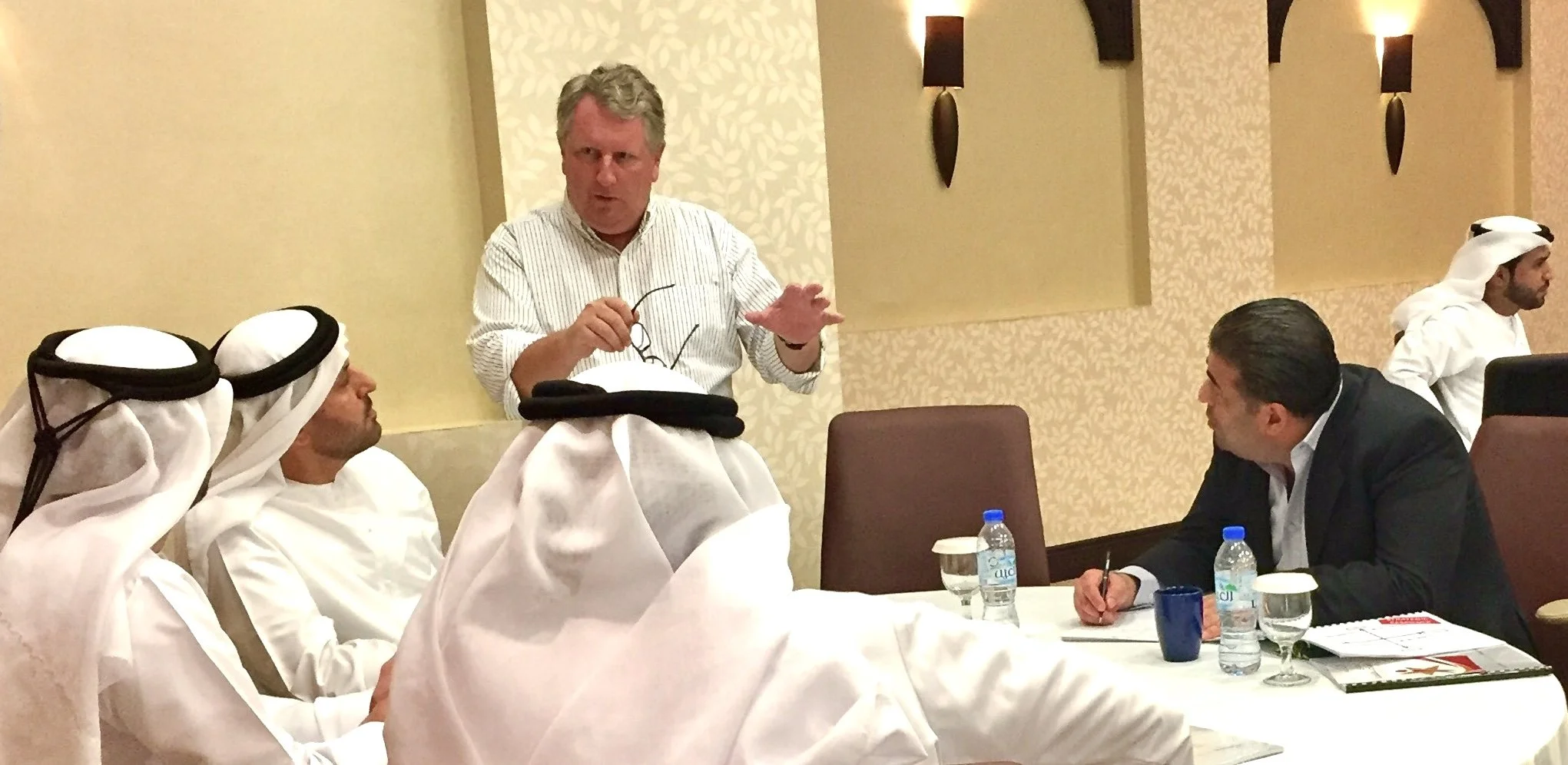
“Woody's experience and knowledge was obvious in his approach to delivery and facilitation, forcing us to think about the future in ways some of us had not before. The alternative scenarios we generated gave us a better understanding of what the future might realistically hold — for our unit and the country as a whole.”
David Anyanwu
Manager, Integrated Threat Assessment Centre, Office of the Prime Minister, Trinidad & Tobago
SCENARIO THINKING ACROSS VERY DIFFERENT WORLDS
I’ve worked with organizations across industries, sectors, continents and cultures — from banking, tech, and hospitality to government bodies, educational institutions, NGOs and international organizations.
The organizations are different. So are the questions they’re grappling with. That’s what makes the work so interesting.
SIGNPOSTS
And then what? We watch what happens.
Scenarios only become truly useful when you identify signposts — observable developments that may indicate that one future landscape is becoming more plausible than another. For example:
A regulatory change
A shift in customer behavior
A new technology reaching a particular threshold
A competitor making an unexpected move
A specific political development
Monitoring early warning signals like these gives your leadership the chance to put a strategic response in place before a major change becomes obvious to everyone. The immense practical value here: You buy time.
The workshop ends. The watching doesn't.
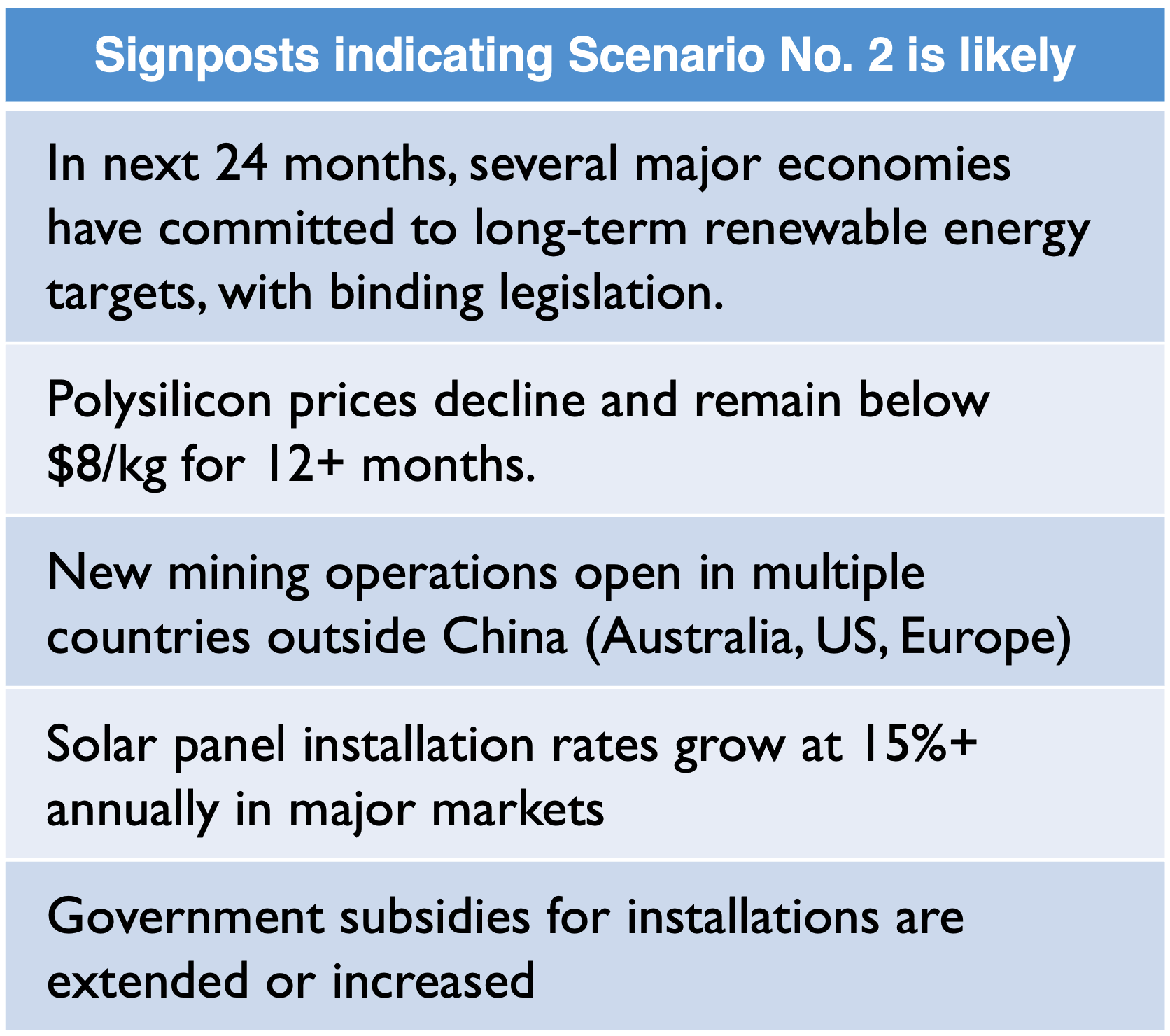
signposts
This example is from a workshop conducted for a solar panel manufacturer.
These indicators were suggested as signposts worth monitoring because they might signal that one of the industry scenarios we developed was beginning to unfold.
TWO WAYS TO ENGAGE
Want to apply scenario planning in your organization?
Here are two ways I can help you:
1. Scenario Generation Workshop
Typically 2 days
For leadership teams or other decision-making groups
Develop several plausible alternative futures around an important strategic question and explore their implications.
2. Scenario Planning Master Class
Typically 2–3 hours
For executives, teams and other groups
Learn the scenario-planning method and how to apply it yourself.